The Intricate Architecture of Human Fingers: A Symphony of Bone, Joint, and Sensation
The human hand, a marvel of evolutionary design, owes much of its incredible functionality to the nuanced structure of its digits – the fingers. Far more than simple appendages, fingers are complex biological instruments, allowing us to perform everything from delicate surgery to powerful gripping. Their anatomy, a sophisticated interplay of bones, joints, muscles, tendons, and nerves, underpins our ability to interact with the world with unparalleled precision and sensory feedback. This article delves into the fascinating "anatomy of human fingers," exploring the components that grant us such extraordinary dexterity.
At a fundamental level, a
finger is a prominent digit on the forelimbs of most tetrapod vertebrate animals, particularly those with prehensile extremities like humans. While short digits are often referred to as toes, the elongated, flexibly articulated digits of the hand are universally known as fingers. In humans, we typically possess five digits on each hand, though variations can occur due to congenital conditions like polydactyly (extra digits) or oligodactyly (fewer digits), or through injury. These five digits are commonly identified as the thumb, index finger, middle finger, ring finger, and little finger (or pinkie). The question of whether the thumb should be classified as a "finger" is an interesting linguistic and anatomical debate, which you can explore further in
Is the Thumb a Finger? Exploring Definition and Anatomy. Regardless of nomenclature, the collective function of these digits is indispensable for daily life.
The Bony Framework: Phalanges and Metacarpals
The structural integrity of our fingers begins with a robust bony foundation. Each hand contains a total of fourteen digital bones, collectively known as
phalanges (singular: phalanx), which form the digits themselves. These are supported by five longer bones located in the palm, called the metacarpals.
The Metacarpal Foundation
The metacarpal bones serve as the proximal base for each of our fingers. There are five metacarpals, each articulating proximally with the carpal bones of the wrist and distally with the first bone of its corresponding digit. These elongated bones form the main body of the palm, providing a sturdy framework from which the fingers extend, facilitating powerful gripping actions and stability during fine motor tasks.
Phalanges: The Digital Building Blocks
The phalanges are the true heroes of finger flexibility and form. While most of our fingers contain three phalanges, the thumb stands apart with only two.
*
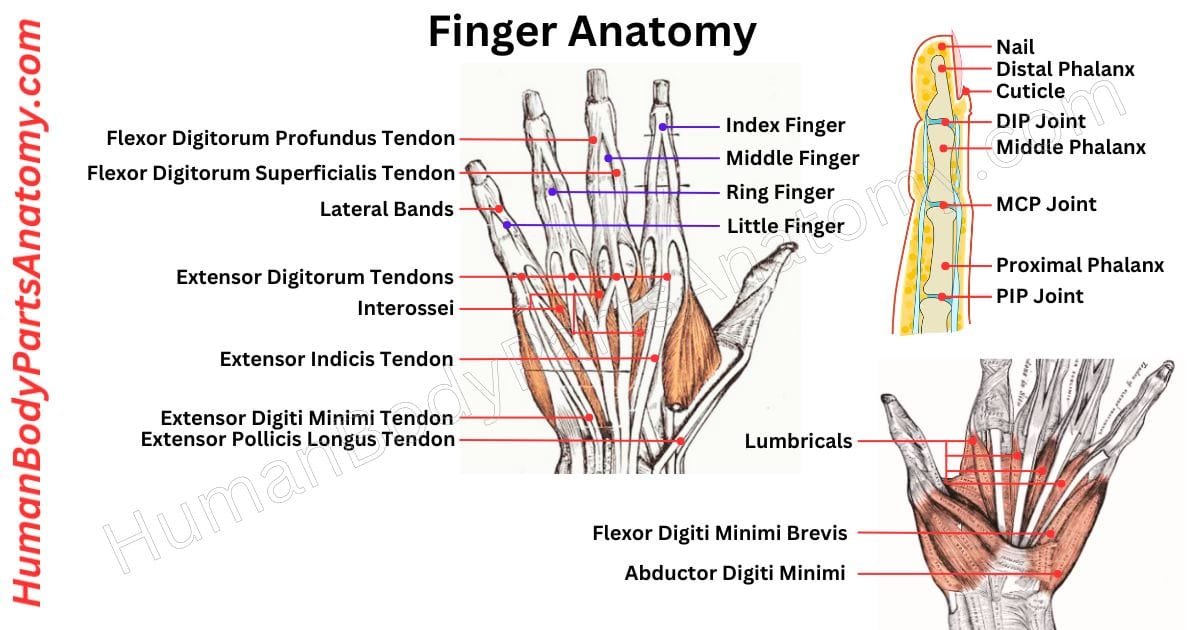
Proximal Phalanx: This is the first bone of each digit, closest to the palm. It articulates with its respective metacarpal bone, forming the knuckle that defines the base of each finger.
*
Middle Phalanx: Present in the index, middle, ring, and little fingers, this bone sits between the proximal and distal phalanges. It is notably absent in the thumb, which directly connects its proximal phalanx to the distal phalanx.
*
Distal Phalanx: The outermost bone of each digit, the distal phalanx supports the fingernail and houses the sensitive nerve endings crucial for fine touch. This is the bone we use for intricate manipulation and pressing.
This segmented arrangement of phalanges, like a series of smaller bones stacked upon each other, is a fundamental design principle seen across many vertebrate species, enabling a range of movements. For a broader look at how these structures vary across the animal kingdom, delve into
Vertebrate Fingers: Anatomy, Evolution, and Diverse Adaptations.
The Marvel of Movement: Joints and Ligaments
The ability of our fingers to bend, straighten, grasp, and manipulate objects stems from their sophisticated joint system. Joints are formed wherever two or more bones meet, allowing for articulation and movement. Each finger and the thumb possesses a distinct set of joints, each designed for specific functions.
The Three Key Joints of Each Finger (Excluding the Thumb)
The index, middle, ring, and little fingers each boast three primary joints, which are largely hinge joints, primarily allowing for flexion (bending) and extension (straightening):
1.
Metacarpophalangeal Joint (MCP Joint): Often referred to as the "knuckle," this joint is located at the base of each finger, where the metacarpal bone meets the proximal phalanx. MCP joints offer a broader range of motion than interphalangeal joints, allowing not only flexion and extension but also some abduction (spreading apart) and adduction (bringing together) of the fingers.
2.
Proximal Interphalangeal Joint (PIP Joint): Situated between the proximal and middle phalanges, the PIP joint is the middle knuckle of each finger. It functions primarily as a hinge joint, crucial for the powerful gripping and curling motion of the fingers.
3.
Distal Interphalangeal Joint (DIP Joint): This is the outermost joint, found between the middle and distal phalanges. Like the PIP joint, it is a hinge joint, enabling the fine-tuning of finger position, essential for tasks like typing, buttoning, or picking up small objects.
The Thumb's Unique Articulation
The thumb, while having fewer phalanges, compensates with an exceptionally versatile set of joints, particularly its unique carpometacarpal (CMC) joint.
*
Thumb Carpometacarpal (CMC) Joint: This critical joint connects the first metacarpal bone of the thumb to the trapezium bone in the wrist. It's a saddle joint, allowing for a wide range of motion, including flexion, extension, abduction, adduction, and crucially, *opposition*. Opposition is the ability of the thumb to touch the tips of the other fingers, a defining characteristic of the human hand and vital for grasping.
*
Thumb Metacarpophalangeal (MCP) Joint: Located at the base of the thumb, this joint connects the first metacarpal to the proximal phalanx. It allows for flexion and extension, though typically less range of motion than the MCP joints of the other fingers.
*
Thumb Interphalangeal (IP) Joint: This is the single joint within the thumb itself, located between the proximal and distal phalanges. It functions as a hinge joint, providing crucial flexion that enables the thumb to curl around objects.
Supporting Cast: Tendons, Muscles, and Nerves
The bones and joints are merely the framework. The true orchestrators of finger movement and sensation are the complex networks of muscles, tendons, ligaments, and nerves.
*
Muscles and Tendons: Extrinsic muscles, located in the forearm, connect to the fingers via long tendons that pass through the wrist and hand. These powerful muscles provide the main force for gripping and bending. Intrinsic muscles, located within the hand itself, allow for the more subtle, fine-tuned movements, such as spreading and bringing the fingers together. Ligaments, strong bands of fibrous tissue, surround and reinforce the joints, providing stability and preventing excessive movement.
*
Nerves and Blood Vessels: Fingers are incredibly sensitive, thanks to a dense network of nerves that relay information about touch, pressure, temperature, and pain to the brain. This rich sensory feedback, facilitated by specialized receptors like Meissner's corpuscles and Pacinian corpuscles, allows for exquisite tactile discrimination. A vast network of blood vessels ensures a constant supply of oxygen and nutrients to these highly active tissues.
Dexterity and Sensory Prowess: Why Fingers Matter
The culmination of this intricate anatomy is the unparalleled dexterity and sensory capability of human fingers. This allows us to perform an astonishing array of tasks, underpinning much of what defines human civilization and interaction.
Grasping, Manipulating, and Fine Motor Skills
Our fingers are the ultimate tools for interaction. They enable us to:
* **Grasp and Hold:** From lifting a heavy box to gently holding a baby, the combined strength and adaptability of our fingers allow for varied gripping patterns.
* **Manipulate Objects:** The ability to rotate a key, turn a page, or thread a needle relies on the precise, coordinated movements of multiple finger joints and muscles.
* **Perform Fine Motor Tasks:** Writing, typing, playing musical instruments, drawing, sculpting, and performing surgery are just a few examples of activities that demand exceptional fine motor control, all orchestrated by our fingers. The opposable thumb, in particular, dramatically enhances our manipulative capabilities, allowing for precision grips that are rare in the animal kingdom.
The Rich Sensory Network
Beyond movement, fingers are primary organs of tactile sensation. The sheer density of nerve endings in our fingertips allows us to:
* **Discern Textures:** Identifying rough, smooth, coarse, or fine surfaces without visual input.
* **Sense Temperature:** Distinguishing hot from cold, crucial for safety and comfort.
* **Feel Pressure and Vibration:** Essential for interacting with tools, gauging force, and even reading braille.
* **Detect Pain:** A vital protective mechanism, alerting us to potential injury.
This sensory feedback loop is constantly informing our brain, allowing for real-time adjustments to our movements and interactions with objects.
Maintaining Finger Health and Function
Given their constant use and vital role, protecting and maintaining the health of our fingers is paramount.
*
Ergonomics: For those engaged in repetitive tasks like typing or using tools, proper ergonomics can prevent conditions like carpal tunnel syndrome or repetitive strain injuries. Ensure your wrist is neutral and your fingers are relaxed.
*
Exercise and Stretching: Gentle finger exercises and stretches can maintain joint flexibility and strengthen the small muscles of the hand, especially beneficial for those prone to arthritis or stiffness.
*
Protection: Wear appropriate gloves when engaging in activities that could lead to cuts, crushing injuries, or extreme temperatures.
*
Listen to Your Body: Persistent pain, swelling, or numbness in the fingers should not be ignored. Consulting a healthcare professional can help diagnose and manage conditions like arthritis, tendinitis, or nerve impingement early.
Conclusion
The human finger is a testament to the elegance and efficiency of biological design. From the fundamental architecture of its phalangeal bones and metacarpal support to the intricate mechanics of its diverse joints and the profound sensory capabilities of its nerve endings, every component plays a crucial role. This symphony of structure and function grants us the extraordinary dexterity and tactile sensitivity that defines our interaction with the world. Understanding the "anatomy of human fingers" not only deepens our appreciation for this everyday marvel but also underscores the importance of caring for these indispensable tools.